
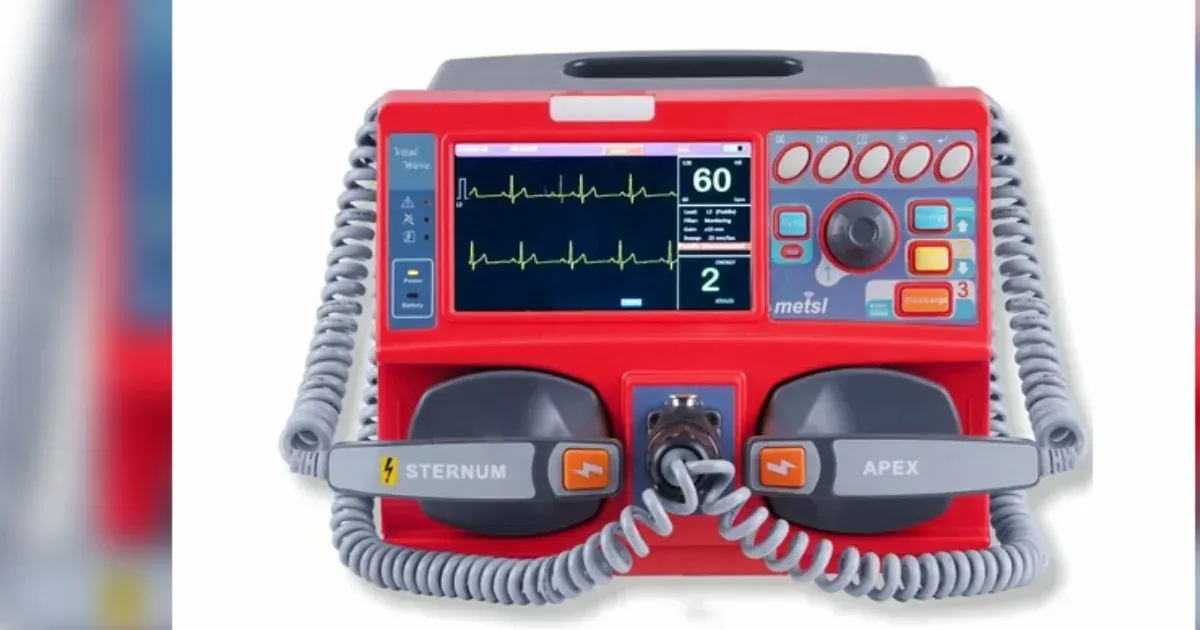
The Maestros Vital Wave AED Defibrillator is a portable biphasic defibrillator designed for emergency cardiac care and monitoring. It supports defibrillation, synchronized cardioversion, and AED modes, with a 7-inch color TFT display, ECG monitoring, built-in thermal printer, rechargeable battery, audio-visual alarms, and self-test functionality. This guide covers its features, uses, specifications, and important factors to consider when choosing a defibrillator in Nepal.
The Maestros Vital Wave is a portable biphasic defibrillator designed for use in emergency and critical-care environments where rapid cardiac assessment and defibrillation may be required. The device supports manual defibrillation, synchronized cardioversion, and AED modes, providing multiple operating options for trained healthcare professionals. It features a 7-inch high-resolution color TFT display with 800 × 480 pixel resolution and can acquire ECG through patient cables and paddles. Maestros also lists audio-visual alarms and a self-test facility with report generation, helping healthcare personnel check the device's operational status.
The Vital Wave combines defibrillation and ECG monitoring functions in a portable unit. Available technical specifications indicate energy selection up to 270 joules, with rapid charging to maximum energy, while the rechargeable 14.8 V/4400 mAh Li-polymer battery provides operation for multiple shocks or several hours of monitoring depending on operating conditions. The device also includes a high-resolution thermal array recorder with a printing speed of 25 mm/sec, allowing ECG and event-related information to be recorded. Its compact design, approximately 5.4 kg weight and 403 × 152 × 324 mm dimensions, makes it suitable for movement within hospital and emergency-care environments.
When selecting a defibrillator in Nepal, hospitals and healthcare facilities should consider the required operating modes, energy range, ECG monitoring capability, battery performance, charging time, alarm functions, printer, patient compatibility, self-test features, and after-sales technical support. The Vital Wave is intended for use by appropriately trained healthcare professionals and should be operated according to the manufacturer's instructions and established emergency-care protocols. AR Surgical Suppliers can provide the Maestros Vital Wave for healthcare facilities looking for a portable defibrillator solution in Nepal.
What Is the Maestros Vital Wave AED Defibrillator?
The Maestros Vital Wave is a portable biphasic defibrillator and cardiac monitoring device. It is designed to provide controlled electrical therapy during appropriate emergency situations while also allowing ECG monitoring through compatible patient connections and paddles.
The device supports Defibrillation, Synchronized Cardioversion, and AED modes. Maestros also lists an in-built high-resolution thermal array printer, audio-visual alarms, and a self-test function with report capability.
Key Features of Vital Wave
The Vital Wave has a 7-inch color TFT display with 800 × 480 pixel resolution. The display can show ECG waveforms, heart rate information, and selected energy information, providing healthcare professionals with visual information during operation.
The device provides energy selection up to 270 joules and is designed for rapid charging at maximum energy. Available specifications report charging to 270 joules in less than 8 seconds, although exact performance can depend on operating conditions and configuration.
Vital Wave also provides ECG acquisition through patient cable and paddles, with support for standard ECG leads. Its listed heart-rate measurement range is 30–240 bpm with stated accuracy of ±2 bpm, and the ECG frequency response is 0.05–40 Hz.
Another important feature is the built-in thermal printer. The recorder uses 57 mm × 20 m thermal paper and prints at 25 mm/sec. Available specifications indicate that printed information can include heart rate, ECG waveform, energy delivery information, date, time, and patient details.
Defibrillation and AED Modes
Defibrillation is an emergency intervention used when an appropriate shockable cardiac rhythm is present. The Vital Wave provides controlled energy selection and supports manual defibrillation as well as AED operation.
In AED mode, the device is designed to provide automated analysis and guide the trained responder through the appropriate operating sequence. Because defibrillation involves potentially life-threatening electrical therapy, the device should only be used by appropriately trained personnel following established emergency protocols.
Synchronized Cardioversion
The Vital Wave also supports synchronized cardioversion. This operating mode is different from standard unsynchronized defibrillation because the electrical discharge is synchronized with the patient's cardiac cycle.
The availability of synchronized cardioversion makes the Vital Wave suitable for clinical environments where healthcare professionals require more than a basic AED function.
ECG Monitoring
ECG monitoring is another major function of the Vital Wave. The device can acquire ECG through patient cables and paddles and provides multiple lead selections, including I, II, III, aVR, aVL, aVF, and V. The 7-inch display can present ECG waveforms along with heart-rate information and selected energy.
The ECG monitoring function allows trained clinical personnel to observe cardiac electrical activity while using the device for emergency cardiac management.
Battery and Power Supply
The Vital Wave is designed to operate from both mains power and its built-in rechargeable battery. Available specifications list a 14.8 V/4400 mAh Li-polymer battery and approximately 8 hours charging time. Published specifications report approximately 40–50 shocks at 270 joules or more than 3 hours of monitoring without printing under specified conditions.
Battery performance can vary depending on the energy selected, monitoring functions, printing, battery condition, and other operating factors. Healthcare facilities should maintain the unit according to the manufacturer's recommended procedures and ensure it remains adequately charged and ready for emergency use.
Thermal Printer and Data Recording
The built-in thermal recorder provides a convenient way to document ECG and treatment-related information. The printer operates at 25 mm/sec and uses 57 mm × 20 m thermal paper. The available product specifications indicate that printouts can contain heart rate, ECG waveform, energy delivery, date, time, and patient information.
This recording capability can be useful for clinical documentation and reviewing events after emergency treatment.
Self-Test and Alarm Functions
The Vital Wave includes audio-visual alarms for technical and functional conditions and provides a self-test facility with report capability. Some product documentation also describes an automatic self-test with a ready indication on the display.
Regular readiness checks are particularly important for emergency equipment. Healthcare facilities should follow the manufacturer's recommended testing, maintenance, battery checks, accessory checks, and servicing procedures.
Adult and Pediatric Compatibility
Available product information describes the Vital Wave as compatible with adult and pediatric patients, depending on the appropriate accessories and configuration.
Before purchasing or deploying the device, healthcare facilities should confirm the supplied paddles, electrodes, and other patient-contact accessories required for their intended patient population.
Where Is the Vital Wave AED Used?
A portable defibrillator such as the Vital Wave may be used in hospitals, intensive-care areas, emergency departments, operating rooms, ambulances, clinics, and other appropriate healthcare environments where trained professionals manage cardiac emergencies.
The exact application depends on the facility's clinical protocols, staff training, available accessories, and the configuration of the device.
Important Specifications to Check When Buying a Defibrillator in Nepal
When purchasing a defibrillator in Nepal, healthcare facilities should examine the available operating modes, maximum energy, charging time, ECG monitoring functions, display size, battery capacity, battery operating time, printer, alarm system, self-test functions, patient compatibility, and available accessories.
Technical support and after-sales service are also important considerations. Emergency equipment needs to remain ready for use, so facilities should have access to appropriate maintenance, servicing, replacement accessories, batteries, electrodes, printer paper, and technical assistance.
Maintenance and Readiness
A defibrillator should be maintained according to the manufacturer's instructions and the healthcare facility's equipment-management procedures. Staff should routinely verify power and battery status, perform the recommended self-tests, inspect cables and paddles, check accessories, and ensure the device is stored in an accessible and appropriate location.
Consumables and patient-contact accessories should also be checked for availability and expiry where applicable. Any servicing, calibration, or repair should be carried out according to the manufacturer's requirements and by appropriately qualified personnel.
Maestros Vital Wave AED Defibrillator in Nepal
The Maestros Vital Wave AED Defibrillator is a portable biphasic defibrillator combining emergency defibrillation functions with ECG monitoring, synchronized cardioversion, AED operation, thermal recording, alarms, and self-test functionality. Its 7-inch display, rechargeable battery, compact design, and multiple operating modes make it suitable for clinical environments requiring portable cardiac-care equipment.
AR Surgical Suppliers provides medical equipment for hospitals, clinics, healthcare institutions, and other professional users in Nepal. The Maestros Vital Wave can be considered by facilities looking for a portable defibrillator with ECG monitoring and multiple emergency-care operating modes.
Conclusion
The Maestros Vital Wave AED Defibrillator combines defibrillation, synchronized cardioversion, AED operation, ECG monitoring, thermal recording, alarms, and self-test functions in a portable unit. Its 7-inch color TFT display, rechargeable battery, energy selection up to 270 joules, and built-in printer provide several functions required for professional emergency and critical-care environments.
For healthcare facilities looking for an AED defibrillator in Nepal, it is important to evaluate the device's energy range, operating modes, ECG capabilities, battery performance, safety features, accessories, maintenance requirements, and technical support. The Maestros Vital Wave should be used only by appropriately trained healthcare professionals and according to the manufacturer's instructions and applicable clinical protocols.