
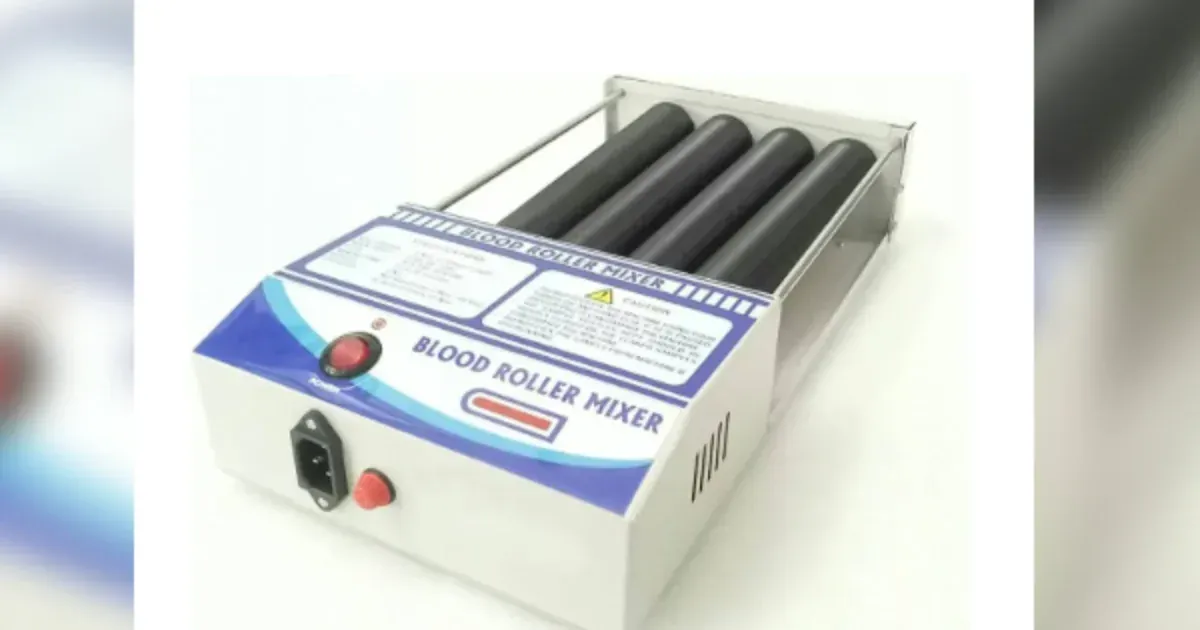
A Blood Roller Mixer is a laboratory device designed for gentle and uniform mixing of blood samples, collection tubes, and other laboratory liquids. Its controlled rolling motion helps maintain consistent sample mixing in blood banks, hospitals, diagnostic laboratories, pathology centers, and research facilities. Learn about its features, uses, benefits, and buying considerations in Nepal.
A Blood Roller Mixer works by placing blood collection tubes or compatible laboratory containers on a series of rotating rollers. As the rollers turn, the tubes rotate and the contents are mixed in a controlled manner. This type of movement is particularly useful for samples that require gentle and consistent mixing rather than vigorous agitation. Different models are designed with different numbers and lengths of rollers, speeds, tube capacities, and operating modes. For example, blood roller specifications used in Nepalese procurement documents include four rollers, a minimum speed of around 30 RPM, a 15–20 minute mixing cycle, and capacity for multiple Vacutainer tubes. However, specifications vary by manufacturer and model, so the actual capacity and operating range should always be checked before purchase.
For laboratories handling regular blood-sample workflows, a roller mixer can make the mixing process more consistent and convenient than manual tube handling. Some models provide continuous operation, while digital versions may allow users to set speed and mixing time and monitor the settings through an LCD or LED display. Modern tube roller mixers can also support different tube sizes and may be suitable for blood samples, biological samples, viscous liquids, and liquid-solid suspensions. Depending on the design, some units use rolling and rocking movement together to achieve thorough but relatively gentle mixing. These features make roller mixers useful for laboratories where repeatable sample preparation and efficient bench workflow are important.
When selecting a Blood Roller Mixer in Nepal, laboratories should consider the number and size of rollers, tube capacity, mixing speed, operating mode, timer availability, construction quality, power requirements, cleaning convenience, and the type of samples that will be handled. A compact fixed-speed model may be suitable for routine blood-sample mixing, while a digital adjustable-speed model may be more appropriate for laboratories that handle different sample types and require greater control over mixing conditions. Power compatibility is also important, particularly for laboratory equipment used continuously. Nepalese technical specifications commonly specify 220–240V, 50Hz single-phase operation, although individual products may have different electrical requirements. Choosing equipment according to the laboratory's actual workload and sample-handling procedure can help ensure reliable and consistent operation.
Key Features of a Blood Roller Mixer
Blood Roller Mixers can differ considerably between models, but common features include multiple rotating rollers, smooth and controlled sample movement, fixed or adjustable mixing speed, continuous operation, timer-controlled operation on selected models, durable laboratory construction, compact benchtop design, and compatibility with different laboratory tubes or containers. Some models provide digital speed and time displays, while others use simple analog controls. Depending on the design, rolling, rocking, or combined rolling-and-rocking motion may be available. These features allow laboratories to select equipment according to sample volume, workflow, required mixing intensity, and available bench space.
Uses of a Blood Roller Mixer
A Blood Roller Mixer is primarily used for controlled mixing of blood samples in clinical laboratories and blood banks. It can also be used for mixing biological samples, laboratory reagents, viscous liquids, and certain liquid-solid suspensions, depending on the model and laboratory protocol. Roller mixers are useful when samples need gentle and consistent movement rather than vigorous shaking. They may therefore be incorporated into workflows involving blood collection tubes, sample preparation, diagnostic testing, pathology procedures, and research applications. The exact application should always follow the laboratory's established procedures and the manufacturer's instructions.
Benefits of Using a Blood Roller Mixer
The main benefit of a Blood Roller Mixer is consistent mechanical mixing. By providing controlled roller movement, the equipment can reduce dependence on manual mixing and help standardize repetitive laboratory procedures. Its benchtop format can also save workspace compared with larger laboratory mixing systems, while continuous-operation models can support routine workflows. Adjustable-speed and timer-equipped models provide additional control when different sample types or protocols require different mixing conditions. A suitable roller mixer can therefore improve convenience, repeatability, and efficiency in laboratories handling regular sample-mixing tasks.
How to Choose the Right Blood Roller Mixer in Nepal
Before purchasing a Blood Roller Mixer in Nepal, consider the laboratory's required tube capacity, roller configuration, speed, mixing time, and operating mode. A laboratory with a high number of samples may benefit from a model with more rollers and greater tube capacity, while a smaller diagnostic laboratory may prefer a compact model. Adjustable-speed operation can provide greater flexibility when different sample types are handled, while a timer can be useful when repeatable mixing periods are required. Construction quality, ease of cleaning, motor reliability, noise level, power supply, available service support, and replacement-part availability are also worth considering. Most importantly, the selected model should be compatible with the laboratory's sample tubes and intended workflow rather than being chosen only on price.
Blood Roller Mixer in Nepal
A Blood Roller Mixer can be a useful addition to clinical laboratories, pathology centers, diagnostic laboratories, hospitals, blood banks, and research facilities in Nepal. AR Surgical Suppliers provides medical and laboratory equipment for healthcare facilities in Nepal, including equipment for laboratory and diagnostic applications. When purchasing a Blood Roller Mixer, customers should confirm the required specifications, tube capacity, operating speed, power supply, warranty, and after-sales support according to their laboratory requirements. Choosing the right configuration can help ensure that the equipment fits the laboratory's daily workload and sample-processing procedures.
Conclusion
A Blood Roller Mixer is a practical laboratory device for controlled and uniform mixing of blood samples and other compatible laboratory materials. Its roller-based movement provides a convenient alternative to manual mixing and can support consistent sample preparation in blood banks, hospitals, diagnostic laboratories, pathology centers, and research facilities. With options ranging from simple fixed-speed models to adjustable digital units with timer functions, laboratories can select a configuration according to their workload and application. If you are looking for a Blood Roller Mixer in Nepal, consider tube capacity, roller design, speed, mixing time, operating mode, construction, power requirements, and after-sales support before making a purchase.